Your doctor says "we need a scan," and suddenly you're facing two confusing acronyms and a price difference of thousands of rupees. MRI and CT scans are both imaging tests, but they work differently, show different things, and are prescribed for different reasons.
What each does, when each is used, what they cost in Delhi NCR, and the questions worth asking before you book.
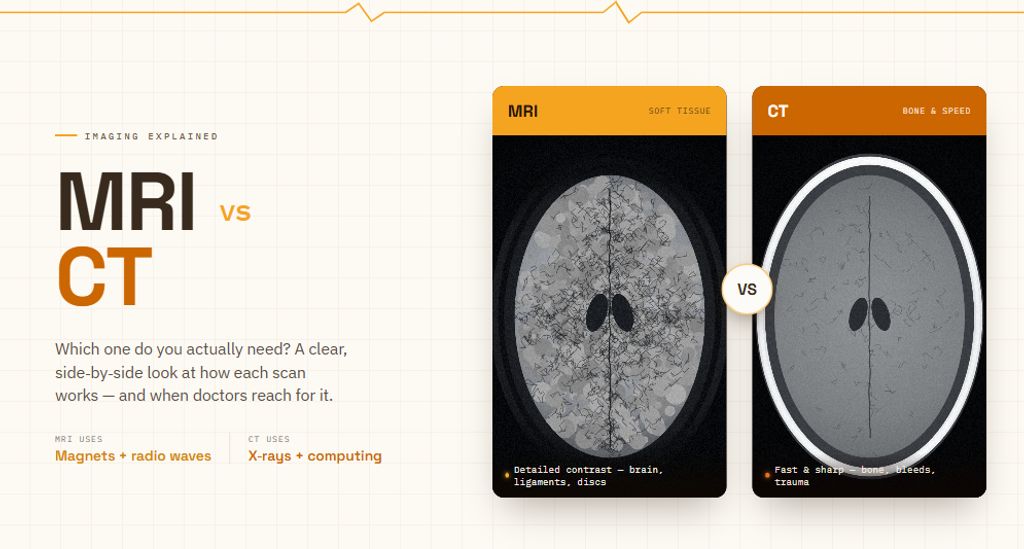
The 30-second answer: A CT scan uses X-rays, takes minutes, and is excellent for bones, chest, and emergencies. An MRI uses magnets (no radiation), takes 20–45 minutes, and is excellent for soft tissues — brain, spine discs, ligaments, joints. Your doctor's choice depends on what they need to see; neither is simply "better."
How each one works
CT (Computed Tomography) takes X-ray images from many angles and combines them into cross-sectional pictures of your body — like viewing a loaf of bread slice by slice. It's fast: the scan itself takes seconds to a few minutes.
MRI (Magnetic Resonance Imaging) uses a strong magnetic field and radio waves — no X-rays at all — to create highly detailed images, especially of soft tissues. It's slower (20–45 minutes) and the machine is noisier and more enclosed.
When doctors prescribe a CT scan
- Emergencies and accidents — head injury, internal bleeding, fractures. Speed matters, and CT is fast.
- Bone problems — complex fractures, bone detail.
- Chest and lungs — infections, nodules, many lung conditions.
- Abdomen — kidney stones, appendicitis, many abdominal complaints.
When doctors prescribe an MRI
- Brain and spine detail — persistent headaches needing detailed imaging, slipped discs, nerve compression, sciatica workups.
- Joints and sports injuries — ligament tears (ACL), meniscus injuries, shoulder problems.
- Soft tissue — muscles, tendons, and organs where fine detail matters.
- When radiation should be avoided — MRI uses none, which matters for repeated imaging.
The differences that affect you as a patient
| CT Scan | MRI | |
|---|---|---|
| Uses radiation? | Yes (X-rays, controlled dose) | No |
| Time in machine | A few minutes | 20–45 minutes |
| Best for | Bones, chest, emergencies | Soft tissue, brain, spine, joints |
| Noise/enclosure | Quieter, more open | Loud, enclosed (ask about earplugs) |
| Metal implants | Generally fine | Must inform the center — some implants aren't MRI-safe |
(Both may be done "with contrast" — a dye that highlights certain structures. It adds cost and a few precautions; your prescription will say if it's needed.)
Why MRI costs more
An MRI machine costs the diagnostic center several times more than a CT machine, scans take 5–10x longer (fewer patients per day), and the images require longer reporting time. That's the price difference — not that one test is "premium" and the other basic. The right test is the one that answers your doctor's question.
Four questions to ask before booking either scan
- "With or without contrast?" — changes both the price and the preparation.
- "Is this urgent, or can I compare centers?" — for non-emergencies, prices for the same scan vary up to 2x across Delhi NCR. (See verified MRI prices in Delhi NCR / CT scan comparison).
- "Do I have any metal implants, pacemaker, or am I pregnant?" — tell both your doctor and the center; it changes which test is safe.
- "Is this center empanelled with my CGHS/ECHS/insurance?" — the same scan could cost you nothing at the right center. (Check empanelled hospitals/clinics/centers)