Understanding the Role of a Bill Processing Agency in ECHS
The Ex-Servicemen Contributory Health Scheme (ECHS) is a vital initiative by the Indian government that ensures healthcare access for veterans and their dependents. But how are medical bills under this scheme managed? That’s where the Bill Processing Agency (BPA) comes in — a crucial link between hospitals, beneficiaries, and ECHS authorities to streamline reimbursements. In this article, we explore how the BPA works, why it matters, and what beneficiaries should know.
What Is ECHS and Why Do We Need a BPA?
ECHS is designed to provide quality healthcare (allopathic and AYUSH) to ex-servicemen drawing pension, as well as to their dependents.
Given the volume of claims — from polyclinics, empanelled hospitals, diagnostic labs, and individual beneficiaries — there needs to be a system to manage, verify, and reimburse bills efficiently and transparently. The BPA fulfills that role.
Specifically, the Department of Ex-Servicemen Welfare (DESW), Ministry of Defence, mandates that medical reimbursement claims under ECHS are processed by a BPA. (Department of Ex-servicemen Welfare) The current appointed agency is UTI-ITSL. (Department of Ex-servicemen Welfare)
Key Functions of the Bill Processing Agency
Receipt and Scrutiny of Claims
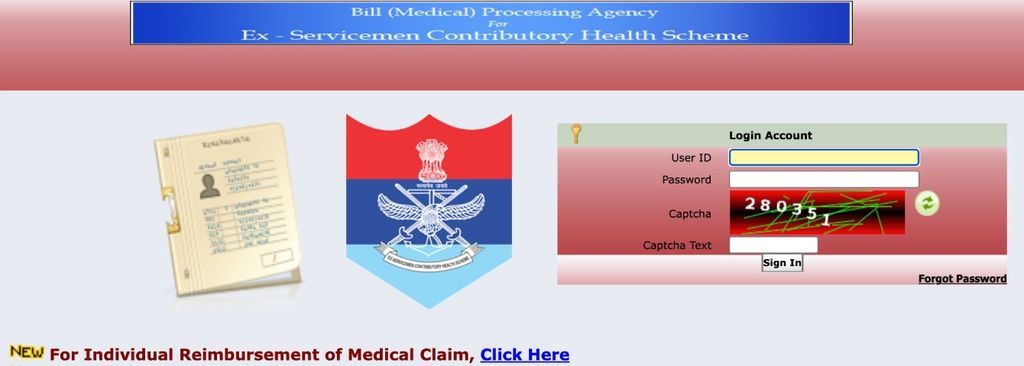
Once a patient is discharged from a hospital, the hospital uploads a scanned copy of the medical bill and supporting documents to the BPA portal. (ECHS)
Simultaneously, hard-copy bills and case papers are forwarded to the relevant ECHS Regional Centre for verification.
The BPA carries out a medical scrutiny — experienced doctors assess whether the treatment, investigations, and procedures are justified.
Financial Assessment
After medical scrutiny, the BPA’s financial team examines the bill, prepares a worksheet recommending how much should be approved, and forwards this to the ECHS competent financial authority (CFA).
The CFA (depending on the claim amount) sanctions the payment. (ECHS)
Payment Facilitation
Once approved, payments are made (via ECS) to the hospital or individual beneficiary. (ECHS)
The BPA also sends the payment and sanction documentation back to the regional centres for records and post-audit.
Service Fee Mechanism
For handling these claims, the BPA is paid a service fee. According to ECHS policy, this fee is 2% of the claimed amount.
This fee covers the BPA’s work, including document verification, medical and financial scrutiny, and managing the portal.
How Beneficiaries Can Use the BPA System
For ECHS beneficiaries (veterans or their dependents) seeking reimbursement, the following steps are essential:
Documentation
After treatment (in-patient or out-patient), collect all relevant bills, discharge summary, clinical/diagnostic reports, prescriptions, and referral letters.
Ensure each document is serially numbered and arranged in chronological order.
For high-value medicines (costing over ₹1,000 per unit), provide MRP or drug certificate.
In case of implants or devices (e.g., pacemakers), attach detailed invoices with batch/serial numbers, manufacturing date, and other required information.
Uploading Claims
Use the BPA portal (managed by UTI-ITSL) to submit scanned claim documents in PDF format. According to standard operating procedures, file size and readability matter. (Navy Foundation Pune Chapter)
For beneficiaries, claims for IPD (in-patient), OPD, and non-available (NA) medicines can be submitted via this portal. (Navy Foundation Pune Chapter)
Even after uploading, a hard copy of the claim must be submitted to the parent polyclinic. (Navy Foundation Pune Chapter)
Timelines
Claims should generally be submitted within 3 months from the date of treatment or discharge. (CGE News - 8th Pay Commission)
This timeline ensures that the BPA can process the claims without unnecessary delays.
Why the BPA Is Important
Transparency & Accountability: By having a dedicated agency to vet each bill, ECHS reduces the risk of overcharging, fraud, or unjustified claims.
Efficiency: The digital portal allows hospitals and beneficiaries to submit claims online, speeding up the reimbursement process.
Expert Scrutiny: Medical professionals at the BPA assess clinical appropriateness; financial teams check for billing accuracy.
Scalability: As ECHS grows and more beneficiaries use empanelled facilities, a centralized agency helps manage the volume.
Regulated Costs: ECHS follows package rates (often aligned with CGHS rates) to standardize payments. (CGE News - 8th Pay Commission)
Challenges & Considerations
While the BPA system offers many benefits, some challenges remain:
Document Quality: Incorrectly scanned or poorly organized documents can lead to delays or rejections.
Portal Downtime: Like any digital system, the BPA portal might occasionally face outages, which can frustrate users. (ECHS)
Variations in Approvals: If a hospital bills outside the standard package rate (for example, for unlisted procedures or high-cost implants), prior approval is often mandatory.
Service Fee Impact: The 2% BPA fee adds a cost overhead which is ultimately borne by the ECHS structure; balancing cost vs benefit is critical.
Conclusion
The Bill Processing Agency (BPA) for ECHS is not just a bureaucratic step — it is the backbone of the reimbursement mechanism, ensuring that claims are valid, justified, and efficiently settled. For beneficiaries, understanding how to file claims correctly, submitting complete documentation, and adhering to timelines are key to a smooth reimbursement journey.
On the institutional side, the BPA ensures accountability and standardization, helping ECHS fulfill its mandate of providing timely, quality healthcare to ex-servicemen and their families.
For ECHS panel hospitals and clinic visit www.theths.com