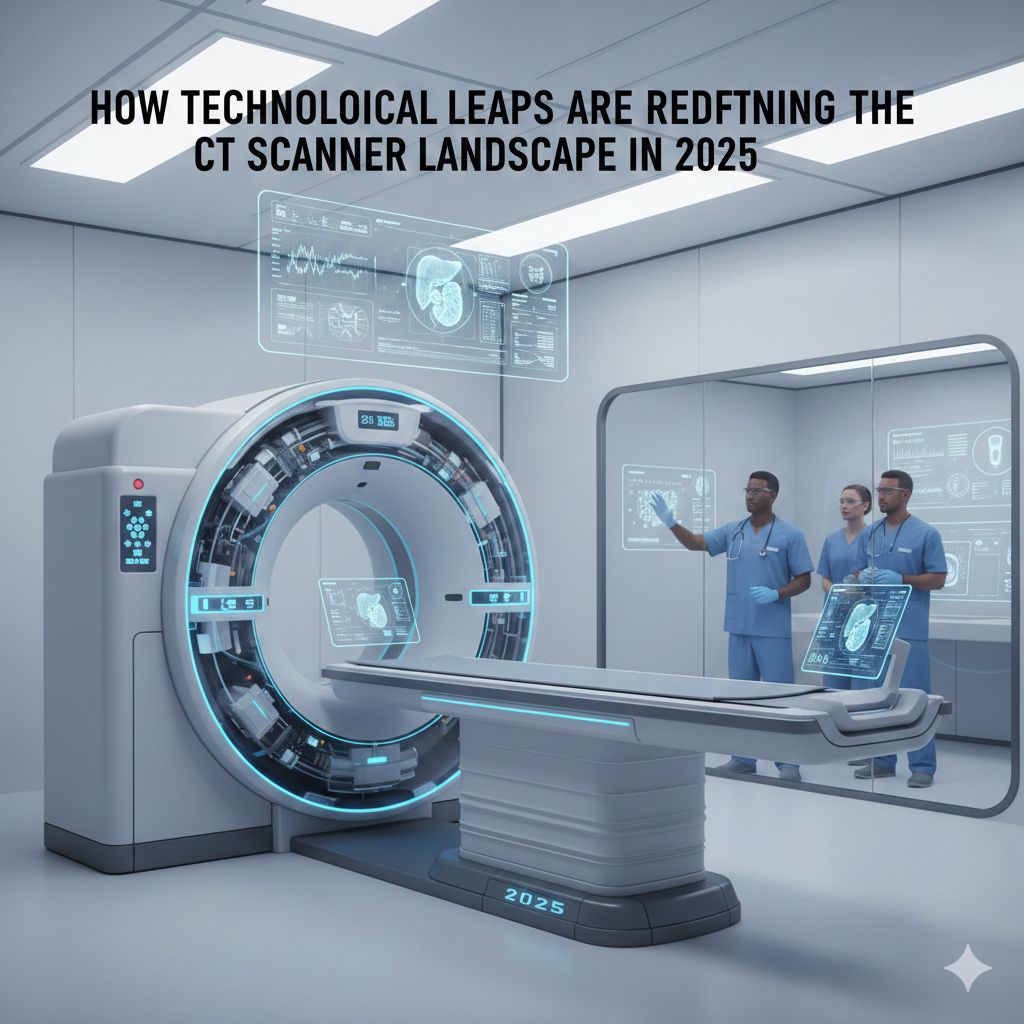
How Technological Leaps Are Redefining the CT Scanner Landscape in 2025
Computed Tomography (CT) has undergone a remarkable transformation over the last decade, and 2025 marks a turning point where innovation is not just about increasing slice count but redefining how imaging contributes to patient care. Today’s CT scanners are engineered to deliver faster imaging, unparalleled clarity, lower radiation exposure, and deeper diagnostic value. With healthcare institutions demanding greater accuracy and efficiency, modern CT technology is now influencing clinical outcomes like never before.
This article explores how the CT scanner market is evolving — from hardware advancements and workflow improvements to AI-driven precision and future-ready clinical applications.
Hardware Advancements Driving the Next Era of CT Imaging
The heart of modern CT evolution lies in its upgraded hardware. Manufacturers are focusing on building systems that push boundaries in speed, stability, resolution, and patient comfort.
1. Detector Innovations
New-generation detector materials capture more photons, reduce noise, and improve low-dose imaging. The shift toward ultra-fast and high-efficiency detectors enables radiologists to visualise subtle structures in the heart, brain, or lungs that were previously difficult to assess.
2. High-Performance X-ray Tubes
Advanced tube designs now support higher heat capacity, longer durability, and ultra-short gantry rotation times. This results in:
Crisp cardiac imaging even in patients with high heart rates
Higher throughput in emergency settings
Reduced motion blur for paediatric or geriatric patients
3. Spectral and Photon-Counting Technology
2025 marks a rapid rise in spectral imaging and the adoption of photon-counting detectors. These systems separate X-ray energies at the detector level, giving radiologists:
Better tissue characterisation
Enhanced plaque detection
Superior metal artefact reduction
This is particularly beneficial for oncology, cardiology, and orthopaedic imaging.
4. Compact & Patient-Friendly Gantry Designs
Slimmer gantries, wider bores, and quieter operation have improved patient experience significantly—especially for claustrophobic, anxious, or paediatric patients.
Software, AI & Workflow Innovations Elevating Clinical Performance
While hardware sets the foundation, software innovations determine the real-world clinical impact.
1. AI-Enhanced Image Reconstruction
Modern CT systems use deep learning reconstruction algorithms that produce:
Sharper images
Higher contrast at lower radiation
Improved visualisation of soft tissues and vascular structures
This AI-driven enhancement helps radiologists make faster, more confident decisions.
2. Automated Workflow & Smart Protocols
CT suites today operate with smart automation features:
Auto-positioning of patients using vision-based alignment
Intelligent protocol selection
One-click cardiac or trauma series
These reduce scan time, minimise technologist fatigue, and increase patient throughput.
3. Integrated Dose Management Systems
Radiation dose awareness is now built directly into the workflow. Advanced algorithms optimise tube current, tailor protocols for each patient, and ensure safe yet high-quality imaging.
Beyond Slice Count: How Modern CT Is Truly Transforming Care
The industry has moved beyond the obsession with slice numbers. The real transformation lies in how CT is reshaping clinical pathways.
1. Cardiac CT Reinvented
With rotational speeds as low as 0.23 seconds and AI-driven motion correction, cardiac CT is now a first-line tool for diagnosing coronary artery disease. The clarity of coronary vessels rivals invasive angiography in many cases.
2. Ultra-Fast Neuro Imaging
Stroke protocols have benefited greatly from:
Whole-brain coverage
Improved perfusion mapping
Rapid detection of bleeds or vessel occlusions
This supports quicker triage and improves patient outcomes in time-critical scenarios.
3. Precision Oncology
Modern CT scanners support:
Tumour characterisation
Treatment monitoring
Radiomics-based prediction models
Spectral imaging helps differentiate tumour tissue from surrounding structures with greater confidence.
4. Emergency & Trauma Efficiency
Motion-tolerant scanners, coupled with AI triage tools, accelerate diagnosis in emergency departments—reducing door-to-decision time significantly.
Clinical Impact: What It Means for Hospitals and Patients Improved Diagnostic Accuracy
Sharper images and spectral capabilities reduce false positives and negatives, enabling clinicians to identify abnormalities earlier and more reliably.
Lower Radiation, Higher Confidence
Advanced noise-reduction algorithms and dose-optimised protocols ensure patient safety without compromising diagnostic quality.
Higher Operational Efficiency
From auto-positioning to instant reconstructions, workflows have become faster and more predictable, allowing hospitals to scan more patients in less time.
Better Patient Experience
Shorter scan times, quieter gantries, and wide-bore systems make CT imaging more comfortable—particularly valuable for children and elderly patients.
Future Outlook: Where CT Technology Is Headed
The next phase of CT evolution will focus on:
1. Full-Scale Photon-Counting Adoption
Expect widespread transition to photon-counting CT, offering superior resolution and tissue differentiation.
2. AI-Driven Autonomous Scanning
Future systems may guide or perform scans with minimal human intervention, improving standardisation across radiology departments.
3. Multi-Organ Functional Imaging
CT scanners will increasingly provide functional insights—blood flow, perfusion, tissue composition—to complement anatomical imaging.
4. Cloud-Based Reporting & Cross-Hospital Collaboration
Cloud-integrated imaging platforms will enable remote reporting, faster consults, and seamless patient management between institutions.
Conclusion
The CT scanner landscape in 2025 is defined by meaningful innovation—where every advancement in hardware, software, and workflow aims to deliver sharper images, safer radiation levels, and better clinical outcomes. As the healthcare sector in India expands and modernises, the demand for high-performance, patient-centric, AI-enabled CT systems will continue to grow.
These technologies are not only transforming how radiology departments operate but also reshaping the future of diagnostics across cardiology, oncology, neurology, and emergency care.
How TheThs helps healthcare teams and patients
If you are evaluating imaging options or want to learn which CT capabilities matter for specific clinical needs, visit TheThs. TheThs connects hospitals, clinical leaders and diagnostic decision-makers with actionable insights — helping you choose the right technology and partners to deliver better care.
The CT scanner landscape of 2025 represents a turning point. With photon-counting detectors, AI-powered reconstruction, ultra-low-dose protocols and broad clinical applications, CT imaging has moved far beyond slice counts. As these technologies scale, they will play an increasingly central role in precision diagnostics and preventive care.
For more articles and resources on medical imaging and healthcare technology, visit TheThs.